Showing posts with label Dave Serrano. Show all posts

Tuesday, June 21, 2011

Playing Smart With Small Ball

Editor's Note: With the impending coaching change at Cal State Fullerton, a topic that has resurfaced is the Titans' historical "small ball" approach. Beginning with Augie Garrido and then through George Horton and the just-departed Dave Serrano, Fullerton teams have generally adopted a style that involves much sacrifice bunting and aggressive baserunning.

Over the past few seasons, that style has become both predictable and reckless. But some small ball devotees refuse to see that the Titans' offensive approach need to adapt to the times. This does not mean abandoning the small ball approach entirely, but rather install an attack that's more diversified and less predictable.

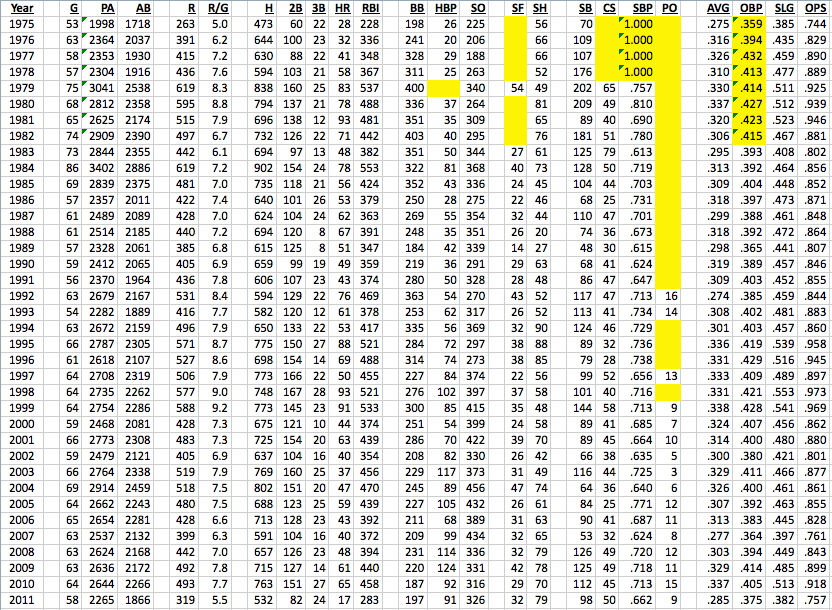
The following is a statistical analysis provided by CSFBaseball contributor CSF, a former Titan who played from 1999-2003. A complete spreadsheet of the statistical information is also here via this link. We thank Cal State Fullerton SIDs Mel Franks and Mike Greenlee for making this available to us.


By CSF

Growing up a lot in the program, you do learn to appreciate a lot of the skills, like bunting. Doing them well can apply a tremendous amount of pressure on a team. Particularly when the offense can be as talented and diverse as we were most of the years I was in school. There were guys with power, lots of guys with speed, guys that were magnets for hit by pitches, guys that hit for very high averages, guys that had patience and guys that could do all kinds of bunts. Having all the weapons is incredibly beneficial. I want that to remain in place.

Like everyone is saying, it was the predictability and overuse that always gets to me. Sacrifice bunting is just one of the tools in the bag. It's not the most important tool. Use everything, use them all randomly. That's what I want. Complete diversity.

I'm going to go back to 2003 because I thought that was the year that we best personified diversity in the offense. That wasn't a great hitting team. It had a bunch of very good hitters, who had talents at a lot of different skills. No huge power threat, but Costa, Dorn, Boyer all had decent power. No unbelievable speed guys, but Costa, Turner, Boyer and Smyres were all fast enough and good baserunners. A lot of guys that could hit for a high average - Pilittere, Costa, Suzuki, Dorn and Prettyman were all over .340 AVG.

That team, which averaged 7.9 runs per game, only had 49 sac bunts on the season. In the 8 years since that team, nobody has scored more runs per game. Every team has sac bunted a lot more often. Other teams have had higher AVG, OBP and SLG. Others have stolen more bases. That team just did all of it. And they gave up a lot less outs per game then the more recent offenses. That's what I want to see again.

I found a better way to demonstrate all this stuff, take averages over a time frame that I think show the difference. The 2002-03 seasons demonstrate the type of offense I'd like to see in terms of acceptable bunting amounts and pickoffs (and I'm very surprised 2002 is in that cut, I thought we stunk that season). Here's a comparison of the average year during the 2002-03 seasons against the average Serrano year, 2008-2011:


(Click to enlarge)


In general, we are talking about virtually identical talent in terms of offensive capabilities. The batting average and on-base percentage are exactly the same. The H, 3B, BB and HBP are basically the same.

The Serrano years have a slight slugging advantage due to a few more home runs, where the 02-03 years hit doubles a little more. The Serrano years also have a slight edge at SB and stolen base percentage.

So you'd think with all other stuff being equal that the years with more stolen bases and home runs would clearly score more runs. That makes sense at least. As we've seen previously, that's not the case.

The 2002-03 years score 1/2 run more per game. That's actually a fairly noticeable difference this time around. Why? Once again, it's giving up outs. The Serrano years have far more sac bunts, pickoffs and caught stealing on the season. It averages out to about 1 extra out per game given up - and over 2 full outs per game - during the Serrano years.

When you spread all of this over an entire season, the Serrano years give away a little over 2 full games worth of outs compared to the 2002-03 offenses. Maybe showing it in a big number like that changes everything. It's a total of about 19 innings more each year being given away in the Serrano years than in 2002-03.

I've had this conversation tons of times. Maybe not with those exact numbers, but with the overall philosophy. People who have been raised to live by the sac bunt refuse to believe that baseball has evolved in any way.

Wednesday, June 15, 2011

What's Next for Fullerton Baseball

By Samuel Chi

When George Horton decided to leave for Oregon four years ago, I was in a panic. But when AD Brian Quinn quickly moved to replace Horton with Dave Serrano, I was both relieved and elated. I thought Serrano was just the right guy to take over the program. He did a great job as the pitching coach under Horton and built UC Irvine into Fullerton's primary rival in the Big West - even beating us in the 2007 CWS. It was a zero-sum game, with Fullerton squarely in the win column and Irvine in the loss column.

He did well in the first season, though we lost in the Supers at Goodwin Field against Stanford. That was OK. Our team was young and despite being a national seed, that Stanford team was better and more experienced than us. No qualms about his performance that season. In fact, we overachieved.

He did better in '09, getting us a No. 2 national seed despite not winning the Big West, the only one of his four Fullerton teams that failed to do so. It also turned out to be his only Omaha team. The Titans breezed through the regionals and Supers, but surprisingly went 2-and-Q in the CWS. That was the first time I questioned his coaching acumen. During the pre-tournament press conference, he brazenly announced that Fullerton would go with its No. 2 pitcher, Noe Ramirez, in the opener against unseeded Arkansas, leaving unsaid that we were "saving" our ace Daniel Renken for the second game. Noe may eventually turn out to be a better pitcher than Renken, but he was a freshman that season and he wasn't ready to handle a Hogs team that rightly felt 'disrespected.' We got blown out in the opener and then dropped the second game against Virginia and was unceremoniously sent home early.

It was in 2010 that I began having some issues with his coaching overall. He pressed the team early and dug them into a hole really for no apparent reason. The Titans battled back during the conference season and won the Big West going away, but all the early-season losses would haunt them, as they failed to secure a national seed and faced a daunting task of having to beat a tough UCLA team on its field in the Supers. But despite not having Gary Brown for just about the entire postseason and having to rebound from a first-game loss at the regionals, the Titans were one out away from going to Omaha again.

That's where everything turned. Little-used Raymond Hernandez was tasked to get the last out, and despite pitching well in the regionals, he was overwhelmed by the moment. After two quick outs that brought us to the edge of our seats, he practically hyperventilated and walked the next batter on four pitches. Up came Tyler Ramatullah, who deposited a 2-1 pitch over the left field fence to save the Bruins. The Titans had a chance in the bottom of the ninth to win it, but amazingly, Richy Pedroza wasn't called on to put down a suicide squeeze, which the moment called for. We stranded the winning run on third with one out, and the loss of that series became the most crushing defeat in Fullerton's glorious history.

The 2011 season was a debacle, and it began in the fall with the poorly handled and abrupt firing of assistant Sergio Brown. Serrano also completely lost this team, both in terms of discipline and fundamentals. It played without much passion and its lack of execution was appalling. It also lost a bunch of big road games early, repeating the 2010 pattern that ultimately cost us a national seed. His coaching was indifferent down the stretch (and now we know why) and while we were bounced out of our own regional by the fourth-seeded Illinois, it was in some ways not that shocking. That loss was a perfect illustration of all of this team's deficiencies, including coaching.

When the Tennessee rumors swirled around after Todd Raleigh's firing, I was more than prepared for Serrano's departure. I knew his ties to the program and certainly would not begrudge him the opportunity. But I was still hoping that he'd return, even with my misgivings over the past two seasons. He was a better coach than seemingly everyone that was available out there - short of George Horton coming back. In his seven seasons as a head coach, he took two teams to the CWS, made the regionals six times, the Supers four times, won 40 games in each of this four seasons at Fullerton and the conference title three times. That's a heck of a resume. We at Fullerton have been spoiled by an amazing run of success and sometimes we take the greatness of our program and coaches for granted.

At the same time, though, I wasn't going to cry over his leaving the program. I wasn't fond of the way he handled the team this season when we clearly underachieved. And there was evidence that his mind was perhaps elsewhere during the crucial late-season stretch. The program has regressed somewhat - at least in the postseason, which is the only thing that counts at Fullerton. So it's just as well that he moved on.

This is a crucial moment for Titan baseball, if we wish to continue our run of excellence. Quinn hit a home run with the Serrano hire four years ago, and he'll have to deliver again. He'll have to look beyond just those with Fullerton ties. That would be nice, but our goal should be getting the best coach available, not settling for someone just because at one time he put on the Fullerton gear. This is a premier job, and one of the most well-paid west of the Rockies. There should be no shortage of quality candidates.

The cupboard isn't bare, but it isn't exactly overflowing, either. If we fail to reach Omaha next year, it would match the longest drought in our Division I history. So the new coach will have much work to do and a short time to accomplish that. Fullerton has never hired a bad coach (in fact, Dave Serrano so far is the only Titan coach who's never won a national championship), and we can't afford this next one to be the first.